
Best HRMS for Logistics Companies in India 2026: A Buyer’s Guide to GPS and Payroll
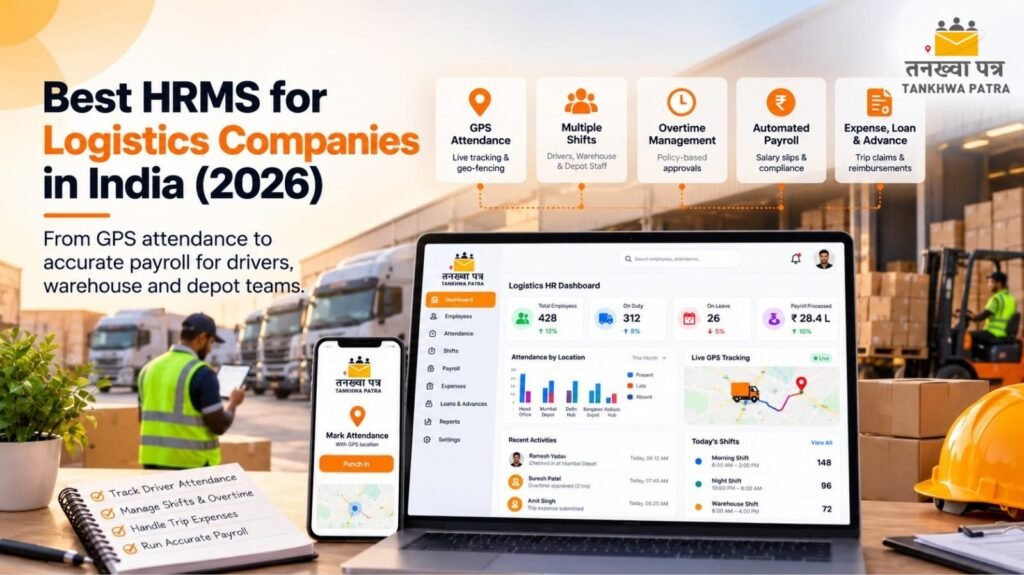
Quick answer: Logistics companies lose payroll accuracy when driver and field attendance lives in WhatsApp photos, paper registers and Excel. The best HRMS for logistics companies links GPS attendance, shifts, overtime and trip expenses directly to payroll. Tankhwa Patra HRMS does this in one system, with live GPS tracking and geo-fencing available as an add-on.
It is the 30th, and the HR executive at a mid-sized transport company is reconciling attendance for 120 drivers, loaders and warehouse staff. Half the drivers marked attendance by sending a selfie on WhatsApp, two pages of the night-shift register are missing, and three supervisors disagree on overtime hours. By the 3rd, employees are calling to ask why their salary is short, and the corrections take another week.
This guide is for owners, HR and accounts teams at transport, courier, warehousing and 3PL businesses across India. It explains what an HRMS for logistics companies should do, why manual payroll breaks down with field staff, how Tankhwa Patra HRMS connects GPS attendance to payroll, a 9-point buyer checklist, a 7-step workflow, mistakes to avoid and which plan to look at.
| ⚠️ Please Note PF, ESI, professional tax, labour welfare fund and overtime rules vary by state and change over time. This guide does not state statutory rates, slabs, limits or due dates, and it is not legal or tax advice. Verify the current rules with the latest government notification or a qualified CA or payroll professional. |
| What is an HRMS for logistics companies? |
An HRMS for logistics companies is software that manages drivers, delivery staff, loaders, warehouse teams and office staff in one place. It records attendance from routes, depots and warehouses, applies shift and overtime rules, and turns that data into payroll, salary slips and compliance reports without anyone retyping it.
Logistics is different from a typical office. Your people are spread across depots, hubs and routes, many work night or rotating shifts, overtime is routine, and advances and trip expenses come up every week. A generic tool built around a 9-to-6 desk job struggles with this. A good HRMS for logistics companies is built for staff who are rarely at a desk.
| What should the best HRMS for a logistics company include? |
The best HRMS for a logistics company should include mobile and biometric attendance, GPS tracking and geo-fencing for field staff, multiple shifts, policy-based overtime, mobile expense claims, loan and advance management, automated payroll with salary slips, PF, ESIC and PT reports, and a self-service app that drivers can use on their phones.
Here is why each one matters for a fleet or warehouse business:
- App punch-in with GPS: drivers and delivery staff mark attendance from wherever they start their duty, and you can see where they punched in.
- Biometric integration: warehouse and depot staff punch on a device, and the data reaches payroll without manual entry.
- Multiple shifts and week-offs: night shifts, rotating rosters and depot-wise holiday calendars are handled by rules, not formulas.
- Overtime rules with approvals: the same overtime policy applies to everyone, so there are fewer disputes on payday.
- Expenses, loans and advances: trip claims and salary advances are tracked and adjusted in the salary slip.
- Compliance reports: PF, ESIC and PT reports come from the same payroll data.
| Why do manual attendance and payroll go wrong in logistics? |
Manual payroll goes wrong in logistics because attendance is captured in too many places: depot registers, biometric machines, WhatsApp photos and supervisor notes. When these are merged by hand in Excel at month-end, overtime gets missed, leave is double-counted, advances are forgotten, and drivers receive salaries that do not match the days they actually worked.
- No proof of location: a WhatsApp selfie does not show whether the driver was at the depot at reporting time.
- Biometric data stuck on the machine: someone has to export it and copy it into the sheet, and rows get shifted.
- Overtime by memory: supervisors approve extra hours verbally, and the number on the salary slip is a guess.
- Cash advances on paper: recoveries are missed or deducted twice.
- One person, one laptop: if the sheet owner is on leave, payroll waits.
| How does Tankhwa Patra HRMS help logistics companies with GPS and payroll? |
Tankhwa Patra HRMS connects attendance, shifts, overtime, leave and expenses to payroll in one system. Drivers and field staff punch in on the app, with live GPS tracking and geo-fencing available as a paid add-on. Warehouse staff can use biometric devices. Payroll then runs on verified data, and salary slips are generated automatically.
The table below maps common logistics problems to features listed on the Tankhwa Patra features page.
| Pain point | Tankhwa Patra feature | What changes |
| Drivers send attendance selfies on WhatsApp | Web and app punch-in/out; live GPS tracking and geo-fencing (paid add-on) | Attendance with location in one system |
| Warehouse biometric data sits on the machine | Biometric and device integration; offline machine data upload via Excel or USB | Depot punches reach payroll without retyping |
| 24×7 shifts and rotating week-offs | Multiple shifts, week-off policies, holiday calendars | Working days counted correctly per employee |
| Overtime disputes every month | Policy-based overtime rules, approvals, automated calculation | Approved hours, one rule for everyone |
| Trip expenses paid in cash, bills lost | Mobile expense claims with proof and approval, adjusted in salary slips | Reimbursements tracked and paid through payroll |
| Salary advances tracked on paper | Loan and advance management | Recoveries are scheduled, not forgotten |
| No record of customer or site visits | Visit management for field teams | Managers see visit records |
| Drivers calling HR for payslips | Employee ESS app: payslips, attendance, leave, reimbursements | Fewer calls to HR |
| Month-end rush for compliance reports | PF, ESIC and PT reports; audit-ready reports | Reports generated from the same payroll data |
| ⚠️ Please Note: confirm these before you buy Route optimisation, vehicle or fleet tracking, fuel management, trip-based or per-km pay, driving licence expiry alerts, bank payment files, Form 16, TDS computation, statutory e-filing and WhatsApp payslip delivery are not listed on the Tankhwa Patra website. If you need any of them, confirm with the Tankhwa Patra team. |
| How do you choose the best HRMS for a logistics company? |
Choose an HRMS that works on the phones your drivers already carry, captures location-verified attendance, and handles shifts, overtime, expenses and advances before payroll runs. Then check its compliance reports, its employee app and its pricing clarity. Use the 9-point checklist below during every demo so you compare vendors on the same points.
9-point buyer checklist
- Drivers can punch in and out from a simple mobile app.
- GPS tracking and geo-fencing are available, and the vendor states clearly whether they are included or an add-on.
- It integrates with your biometric devices, or accepts offline machine data via Excel or USB.
- It handles multiple shifts, night shifts, week-off policies and holiday calendars.
- Overtime is calculated from policy rules, with an approval step.
- It supports multiple salary structures for drivers, helpers, warehouse and office staff.
- Expense claims, loans and advances are adjusted in payroll automatically.
- It generates PF, ESIC and PT reports and audit-ready records from payroll data.
- The vendor demos it with your own scenarios and lists plans clearly on its pricing page.
| Spreadsheet vs HRMS: which works better for logistics payroll? |
Spreadsheets work for a handful of staff in one location, but they break down once you have drivers on routes, several depots and rotating shifts. An HRMS captures attendance at the source, applies the same rules every month and generates salary slips in bulk, so HR spends payroll week verifying numbers instead of rebuilding them.
| Area | Spreadsheet | HRMS |
| Attendance capture | Registers and WhatsApp photos typed into Excel | App, biometric and GPS data in one system |
| Proof of location | Supervisor’s word | Live GPS tracking and geo-fencing (add-on) |
| Shifts and week-offs | Manual formulas in each sheet | Configured shift and week-off policies |
| Overtime | Calculated by hand, often disputed | Policy rules with approvals |
| Expenses and advances | Separate sheets, easy to miss | Claims and recoveries adjusted in payroll |
| Salary slips | Built one at a time | Generated automatically in bulk |
| Compliance reports | Compiled manually | PF, ESIC and PT reports from payroll data |
| Employee queries | Calls and messages to HR | Self-service app |
| Access and security | One file, anyone with the file can edit | Role-based security and digital records |
| What does a GPS attendance to salary slip workflow look like? |
In an HRMS, the workflow runs from policy setup to salary slip in seven steps. You define shifts and rules once, staff punch in through the app or biometric devices, supervisors approve exceptions during the month, and HR runs bulk payroll on data that is already verified. Here is how it works for a logistics team.
7-step workflow
- Set up rules: create shifts, week-off policies, holiday calendars, leave policies and overtime rules for each depot or warehouse.
- Set up capture points: define geo-fences for depots and hubs (with the GPS add-on) and connect biometric devices at warehouses.
- Staff punch in: drivers and delivery staff use the app; warehouse staff use the biometric device or upload offline machine data.
- Supervisors monitor: live attendance monitoring shows who has reported; managers approve leave and overtime.
- Expenses are claimed: staff submit trip expenses with proof from the app, and managers approve them.
- HR runs payroll: bulk salary processing pulls in attendance, leave, overtime, approved expenses and advance recoveries, then HR verifies.
- Slips and reports go out: salary slips are generated automatically and appear in the ESS app, and PF, ESIC and PT reports are generated.
| 🧮 Illustrative example (not real data) A delivery driver has a fixed monthly gross of ₹18,000. His company’s policy counts 26 working days in the month. He was present 25 days and had 1 day of loss of pay. Per-day salary: ₹18,000 ÷ 26 = ₹692 (rounded). Earned salary: ₹18,000 − ₹692 = ₹17,308. Add 10 approved overtime hours at an illustrative ₹100 per hour (₹1,000) and an approved trip expense of ₹1,200. Total before deductions: ₹19,508. PF, ESI, professional tax and any advance recovery are then deducted under current rules and company policy. Per-day methods also vary by company. All figures are illustrative. |
| ✅ Result Every number on the salary slip traces back to a punch, an approval or a claim. When the driver asks why his pay changed, HR can show him the record instead of searching through a spreadsheet. |
| What mistakes should logistics companies avoid when buying an HRMS? |
The most common mistakes are buying an office-first tool, assuming GPS is included in the base price, skipping a real test with drivers, and expecting the software to file returns. Each one leads to rework after go-live. Check the points below during the demo, before you sign, so the system fits how your fleet works.
- Buying for the office, not the field: if drivers cannot use the app easily, attendance goes back to WhatsApp.
- Assuming GPS is free: on Tankhwa Patra, live GPS tracking is a paid add-on. Check this for every vendor.
- Not testing with real staff: ask two or three drivers and a depot supervisor to try the app during the trial.
- Ignoring warehouse devices: confirm your existing biometric machines can integrate, or plan an offline upload.
- Migrating messy data: clean employee master data, salary structures and leave balances before you import them.
- Confusing reports with filing: an HRMS can generate PF, ESIC and PT reports; filing and legal compliance stay with you and your CA.
- Not listing must-haves: if you need trip-based pay or bank payment files, confirm with the vendor in writing.
| Which Tankhwa Patra plan suits a logistics company? |
Tankhwa Patra offers three plans, Dreamer, Performer and Achiever, and higher plans add more modules. Live GPS tracking is a paid add-on on top of a plan. The right plan depends on which modules you need beyond payroll and attendance, so compare them on the pricing page and confirm the details with the Tankhwa Patra team.
A simple way to decide before you speak to the team:
- Small fleet, one depot: list your payroll, attendance, shift and overtime needs, then check which plan covers them and whether you need the GPS add-on.
- Several depots or warehouses: add biometric integration, visit management and compliance reports to your list.
- Growing headcount: if you also need onboarding, recruitment, performance management, asset management or a helpdesk, compare the higher plans.
See current plans on tankhwapatra.com/pricing. Some features depend on the plan, so confirm what is included in writing.
| Frequently asked questions |
1. What is the best HRMS for logistics companies in India?
The best HRMS for logistics companies in India is one that captures driver and warehouse attendance at the source and feeds it straight into payroll. Look for app and biometric attendance, GPS tracking, shift and overtime rules, expense claims, salary slips and PF, ESIC and PT reports. Tankhwa Patra HRMS covers these in one system.
2. Can an HRMS track driver attendance with GPS?
Yes. Many HRMS tools let drivers punch in from a mobile app with their location recorded. In Tankhwa Patra HRMS, live GPS tracking and geo-fencing are available as a paid add-on, so attendance can be checked against depot or hub locations. Route optimisation and vehicle tracking are not listed, so confirm with the Tankhwa Patra team.
3. How is overtime calculated for drivers in payroll software?
Payroll software calculates overtime from recorded punch-in and punch-out times against the shift and overtime policy you set. Approved extra hours are multiplied by the rate in your policy and added to the salary. Overtime rules and rates under labour law vary by state, so verify them with a qualified CA or payroll professional.
4. What should a salary slip format for drivers include?
A salary slip format for drivers, also searched as tankhwa patra in Hindi, should show employee and company details, pay period, days worked and loss of pay, earnings such as basic pay, HRA, allowances and overtime, approved reimbursements, deductions such as PF, ESI, professional tax and advance recovery, and the final net pay.
5. Does Tankhwa Patra file PF and ESIC returns for logistics companies?
No. Tankhwa Patra HRMS generates PF, ESIC and PT reports and audit-ready reports from your payroll data, which makes filing easier. Filing returns and staying compliant remain the employer’s responsibility. For statutory e-filing, Form 16 or TDS computation, confirm with the Tankhwa Patra team and work with your CA or payroll professional.
6. Can warehouse biometric attendance be linked to payroll?
Yes. Tankhwa Patra HRMS supports biometric and device integration, and it also accepts offline machine data uploaded through Excel or USB. Once punches are in the system, they combine with shifts, leave and overtime rules so payroll runs on the same data. Check compatibility of your specific device models with the Tankhwa Patra team.
| Conclusion |
For a logistics business, payroll is only as accurate as the attendance behind it. When drivers, loaders and depot staff punch in through an app or biometric device, and shifts, overtime, expenses and advances follow clear rules, month-end becomes a check rather than a rebuild.
Use the checklist in this guide to compare vendors, test the app with your own drivers, and confirm any feature that is not listed before you sign. If you want GPS-backed attendance and payroll in one place, Tankhwa Patra HRMS is worth a demo.
Book a Free Demo or Start a Free Trial of Tankhwa Patra HRMS at tankhwapatra.com.
Call: +91 70418 01390 | +91 89809 38940
Disclaimer: The information provided is for general informational purposes only. It may vary over time, so we recommend verifying the details independently before making any decisions.
