
Best HRMS for Mining and Steel Companies in India 2026: A 9-Point Selection Checklist
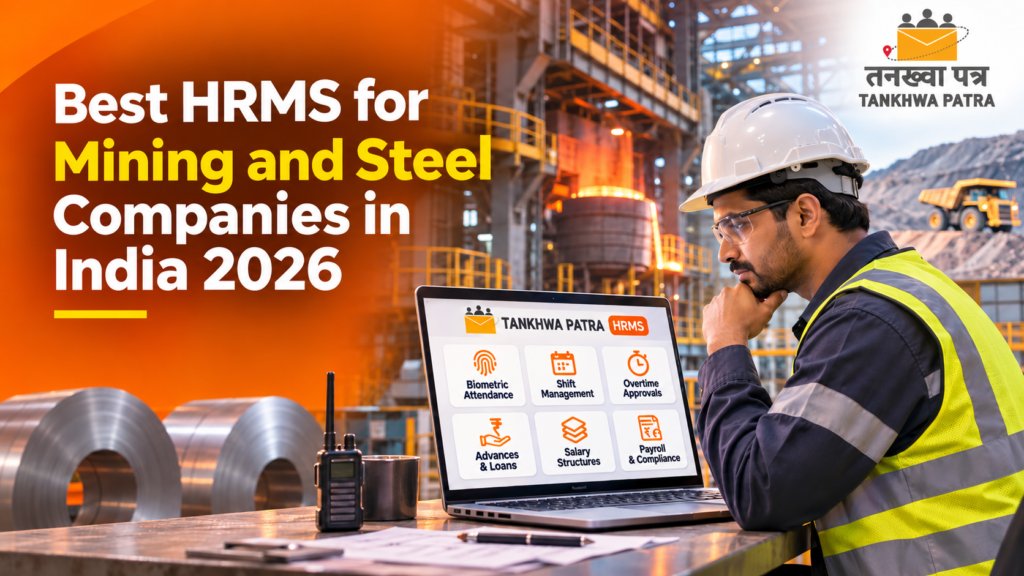
Tick off these nine points before you buy, so round-the-clock shifts, remote-site attendance and overtime turn into accurate payroll.
Quick answer: Mining and steel companies lose payroll accuracy when continuous shifts, remote-site attendance, overtime and advances are tracked in shift logs and Excel. The best HRMS for mining and steel companies links biometric and app attendance, shift and overtime rules to payroll. Tankhwa Patra HRMS does this in one system and generates salary slips and PF, ESIC and PT reports.
It is the 30th at a mid-sized steel re-rolling mill with a captive mine 60 kilometres away. The HR executive is matching three shift logs from the plant against a biometric export that failed to sync from the mine site for four days. Furnace crews ran extra hours during a shutdown, two supervisors gave cash advances, and a dozen new helpers joined mid-month. By the 3rd, workers are at the time office asking why their pay is short.
This guide is for owners, plant heads, HR and accounts teams at mines, quarries, steel plants, re-rolling mills, foundries and ferro-alloy units across India. It explains what an HRMS for mining and steel companies must do, why manual payroll breaks down, a 9-point selection checklist, how Tankhwa Patra HRMS handles shifts and overtime, a 7-step workflow, mistakes to avoid and which plan to look at.
| ⚠️ Please Note Minimum wages, PF, ESI, professional tax, overtime, working-hour and mine or factory safety rules vary by state and by type of establishment, and they change over time. This guide does not state statutory rates, slabs, limits or due dates and is not legal or tax advice. Verify current rules with the latest government notification or a qualified CA or payroll professional. |
| What is an HRMS for mining and steel companies? |
An HRMS for mining and steel companies is software that manages operators, crew, maintenance staff, supervisors, engineers, drivers and office staff in one place. It records attendance at plants and remote sites, applies shift, leave and overtime rules, runs payroll on different salary structures, generates salary slips and compliance reports, and tracks joining and exits.
Heavy industry runs differently from an office. Furnaces and crushers run round the clock, so shifts never stop. Mine sites can be far from the head office with patchy internet. Shutdowns and breakdowns create sudden overtime, and new helpers join and leave often. A good HRMS for mining and steel companies treats shift attendance as the foundation of payroll.
| Why does manual payroll go wrong at mines and steel plants? |
Manual payroll goes wrong at mines and steel plants because shift logs, biometric data from different sites, overtime slips and supervisor advances are kept separately. When HR merges them at month-end, shutdown overtime is missed, site data arrives late, advances are forgotten, and workers receive salary slips that do not match the shifts they actually worked.
- Remote-site data delays: the mine-site machine fails to sync, and punches are retyped days later.
- Three shifts, three logs: each shift in-charge keeps a separate record.
- Shutdown overtime on paper: extra hours during maintenance shutdowns are noted on slips that get lost.
- Cash advances from supervisors: recorded in a notebook, if at all.
- Frequent joining and exits: new helpers are paid late because their records are incomplete.
| How do you choose an HRMS for a mining or steel company? |
Choose an HRMS for a mining or steel company by testing it on a real shutdown or peak month. Check that it captures attendance at plants and remote sites, handles continuous shifts, applies overtime rules with approvals, recovers advances, and protects wage data by role. Use the 9-point checklist below to compare vendors on the same points.
9-point buyer checklist
- Biometric integration: it connects to the biometric devices at your plant gate and mine site.
- Offline data upload: if a remote site loses internet, machine data can be uploaded through Excel or USB.
- Site attendance for mobile crews: staff who move between sites can punch in on an app, with GPS and geo-fencing if needed.
- Continuous shifts: it handles multiple shifts, night shifts, rotating week-offs and holiday calendars.
- Overtime with approvals: overtime is calculated from policy rules, and only approved hours are paid.
- Advances and loans: advances are recorded and recovered automatically in payroll.
- Separate salary structures: operators, crew, supervisors, engineers and office staff each keep their own structure.
- Compliance reports and security: it generates PF, ESIC and PT reports and keeps wage data behind role-based access.
- A real-data demo: the vendor runs one month of your own roster and lists plans clearly on its pricing page.
Print this list and take it into every demo. Any point the vendor cannot show on screen with your data is a point to confirm in writing before you sign.
| How does Tankhwa Patra HRMS help mining and steel companies? |
Tankhwa Patra HRMS connects shifts, biometric and app attendance, leave, overtime, advances and payroll in one system. Punches come in from biometric devices or are uploaded offline from remote sites, overtime goes through approvals, and advances are recovered automatically. Payroll runs on verified data, salary slips are generated automatically, and workers can see them in the employee app.
The table below maps common plant and mine HR problems to features listed on the Tankhwa Patra features page.
| Pain point | Tankhwa Patra feature | What changes |
| Mine-site machine fails to sync | Offline machine data upload via Excel or USB | Site punches still reach payroll |
| Separate shift logs for each shift | Biometric and device integration; live attendance monitoring | One attendance record per worker |
| Crews moving between sites | App punch-in; live GPS tracking and geo-fencing (paid add-on) | Attendance with location |
| Continuous three-shift operations | Multiple shifts, week-off policies, holiday calendars | Working days counted correctly |
| Shutdown overtime disputes | Policy-based overtime rules, approvals, automated calculation | Only approved hours are paid, under one rule |
| Cash advances from supervisors | Loan and advance management | Recoveries are scheduled in payroll |
| Different pay for each role | Custom and multiple salary structures, automatic CTC calculator | Each role keeps its own structure |
| PPE and tools not returned at exit | Asset management | Issued items recorded per employee |
| Vehicles and vendors at the gate | Visitor gate pass | Gate entries are recorded |
| Workers queuing at the time office | Employee ESS app; Mirayo AI chatbot | Workers check payslips and leave on their phones |
| ⚠️ Please Note: confirm these before you buy Contract labour or contractor management, statutory mine or factory registers and forms, safety training and medical examination tracking, automatic shift allowance per shift worked, production incentives, wage agreement arrears, housing or canteen deductions, multi-site consolidation, integration with a specific ERP, face recognition, bank payment files, Form 16, TDS computation, statutory e-filing and WhatsApp payslips are not listed on the Tankhwa Patra website. Confirm these with the Tankhwa Patra team. |
| Spreadsheet vs HRMS: which works better for mining and steel payroll? |
A spreadsheet can work for a small quarry with a few workers on one shift. Once you run continuous shifts, remote sites and shutdown overtime, it becomes slow and error-prone. An HRMS applies the same shift, leave and overtime rules every month and generates salary slips in bulk, so HR reviews payroll instead of rebuilding it from shift logs.
| Area | Spreadsheet | HRMS |
| Attendance | Shift logs and biometric exports typed into Excel | Device integration or offline upload |
| Remote sites | Data arrives late by email or pen drive | Offline upload or app punch-in |
| Shifts and week-offs | Manual formulas per shift | Shift and week-off rules in one system |
| Overtime | Paper slips, often disputed | Policy rules with approvals |
| Advances | Supervisor notebook | Recoveries adjusted in payroll |
| Salary slips | Built one at a time | Generated automatically in bulk |
| Compliance reports | Compiled manually | PF, ESIC and PT reports from payroll data |
| Worker queries | Queue at the time office | Self-service app |
| Data access | Anyone with the file can see all wages | Role-based security |
| What does a shift attendance to salary slip workflow look like at a steel plant or mine? |
In an HRMS, a steel plant or mine moves from shift attendance to salary slip in seven steps. You set shift, leave and overtime rules once, capture punches at the plant and sites, let shift in-charges approve leave and overtime, and run bulk payroll on data that is already checked. Here is how a typical month works, including a shutdown.
7-step workflow
- Set up rules: create shifts, week-off policies, holiday calendars, leave policies and overtime rules for each plant and site.
- Set up salary structures: configure separate structures for operators, crew, supervisors, engineers and office staff.
- Capture attendance: biometric devices record punches; remote sites upload offline machine data, and mobile crews use the app.
- Shift in-charges monitor: live attendance shows who has reported; in-charges approve leave and shutdown overtime.
- Advances and claims are recorded: advances are entered for recovery, and approved expense claims are added.
- HR runs payroll: bulk salary processing pulls in attendance, leave, overtime, approved expenses and advance recoveries, then HR verifies.
- Slips and reports go out: salary slips are generated automatically and appear in the ESS app, and PF, ESIC and PT reports are generated.
| 🧮 Illustrative example (not real data) A furnace operator has a fixed monthly gross of ₹28,000. The plant’s policy counts 26 working days in the month. He had 1 day of loss of pay. Per-day salary: ₹28,000 ÷ 26 = ₹1,077 (rounded). Earned salary: ₹28,000 − ₹1,077 = ₹26,923. Add 20 approved shutdown overtime hours at an illustrative ₹120 per hour (₹2,400). Total before deductions: ₹29,323. PF, ESI, professional tax and any advance recovery are then deducted under current rules and company policy. Per-day methods and overtime rates vary by employer and state. All figures are illustrative. |
| Result Every line on the salary slip traces back to a punch, an approval or an advance record. When an operator asks about his shutdown overtime, HR can show the record in minutes. |
| What mistakes should mining and steel companies avoid when choosing an HRMS? |
The most common mistakes are testing in a quiet month, ignoring connectivity at remote sites, skipping overtime and advance rules, and expecting the software to handle contract labour or statutory registers. Each one causes rework after go-live. Check the points below during the demo so the system fits how your plant and sites actually run.
- Demoing in a quiet month: test with a shutdown or peak-production month, when overtime is highest.
- Ignoring remote sites: confirm how site data reaches payroll when internet drops.
- Skipping overtime policy setup: write the policy down before go-live, or disputes move into the software.
- Leaving advances outside the system: supervisor advances must be recorded for recovery.
- Migrating messy data: clean worker records, salary structures and leave balances before importing them.
- Assuming heavy-industry features: contractor management and statutory registers are not listed; confirm in writing.
- Confusing reports with filing: an HRMS can generate PF, ESIC and PT reports; filing stays with you and your CA.
| Which Tankhwa Patra plan suits a mining or steel company? |
Tankhwa Patra offers three plans, Dreamer, Performer and Achiever, and higher plans add more modules. Live GPS tracking for mobile crews is a paid add-on. The right plan depends on whether you need only payroll, attendance and shifts, or also recruitment, onboarding, assets and performance management. Compare plans on the pricing page and confirm details with the Tankhwa Patra team.
A simple way to decide before you speak to the team:
- Single plant or quarry: list your payroll, attendance, shift and overtime needs, then check which plan covers them.
- Plant with remote sites: add offline upload, advances, compliance reports and the GPS add-on to your list.
- Larger or growing group: if you also need recruitment, asset management, performance management, a helpdesk or ERP integration, compare the higher plans.
See current plans on tankhwapatra.com/pricing. Some features depend on the plan, so confirm what is included in writing.
| Frequently asked questions |
1. What is the best HRMS for mining and steel companies in India?
The best HRMS for mining and steel companies in India is one that captures attendance at plants and remote sites, handles continuous shifts and shutdown overtime, recovers advances and feeds everything into payroll. Look for salary slips, PF, ESIC and PT reports, role-based security and a worker app. Tankhwa Patra HRMS covers these in one system.
2. How do mines track attendance at remote sites with poor internet?
Most mines place biometric devices at site entrances and link them to an HRMS. When internet is unreliable, machine data can be uploaded offline through Excel or USB, so payroll still uses actual punches. Crews that move between sites can punch in on a mobile app, with GPS tracking and geo-fencing available as an add-on.
3. How is overtime calculated for steel plant workers during a shutdown?
Payroll software calculates overtime from recorded punch-in and punch-out times against the shift and overtime policy you set. Approved extra hours during a shutdown are multiplied by the rate in your policy and added to the salary. Overtime and working-hour rules vary by state, so verify them with a qualified CA or payroll professional.
4. What should a salary slip format for mine and plant workers include?
A salary slip format for mine and plant workers, also searched as tankhwa patra in Hindi, should show employee and company details, pay period, days worked and loss of pay, earnings such as basic pay, DA, HRA, allowances and overtime, deductions such as PF, ESI, professional tax and advance recovery, and the final net pay.
5. Can Tankhwa Patra manage contract labour at mines and steel plants?
Contract labour and contractor management are not listed on the Tankhwa Patra website, so confirm with the Tankhwa Patra team. What is listed includes biometric integration, multiple shifts, policy-based overtime, custom salary structures and bulk salary processing. Companies that rely heavily on contractors should check how contract workers would be handled before choosing a plan.
6. Does Tankhwa Patra file PF and ESIC returns for steel companies?
No. Tankhwa Patra HRMS generates PF, ESIC and PT reports and audit-ready reports from your payroll data, which makes filing easier. Filing returns and staying compliant remain the employer’s responsibility. For statutory e-filing, Form 16 or TDS computation, confirm with the Tankhwa Patra team and work with your CA or payroll professional.
| Conclusion |
At a mine or steel plant, payroll is only as accurate as the shift attendance behind it. When punches from the plant and remote sites, overtime approvals and advances flow straight into payroll, shutdown months stop being a month-end crisis, and workers get salary slips they can trust.
Take the 9-point checklist into every demo, test with a real shutdown or peak month, and confirm anything that is not listed before you sign. If you want shift attendance, overtime and payroll in one place, Tankhwa Patra HRMS is worth a demo.
Book a Free Demo or Start a Free Trial of Tankhwa Patra HRMS at tankhwapatra.com.
Call: +91 70418 01390 | +91 89809 38940
Disclaimer: The information provided is for general informational purposes only. It may vary over time, so we recommend verifying the details independently before making any decisions.
