
Salary Advance Management: How to Track Salary Advances and Employee Loans Without Messy Ledgers
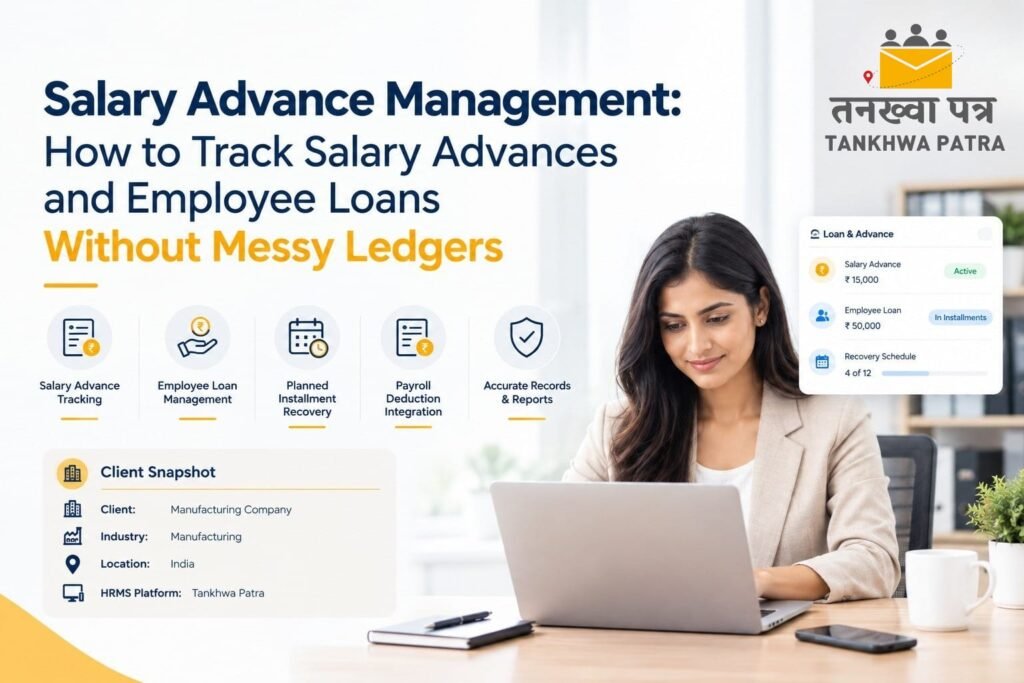
Keep one clear record of every advance and loan, recover it through payroll in planned installments, and end the month-end arguments over who owes what.
Quick answer: Salary advance management means recording every advance and employee loan in one place, agreeing a recovery schedule, and tracking each salary deduction until the balance reaches zero. Spreadsheets and paper registers make this error-prone. Tankhwa Patra HRMS lists loan and advance management in its payroll module, so these records sit with salary processing instead of scattered ledgers.
It is the 28th, and the accounts executive at a 120-person manufacturing unit is closing payroll. One spreadsheet lists advances paid in March, a paper register holds loan installments written in by hand, and a third file is a copy someone saved last month. Two employees insist their loans are already cleared, and one deduction was simply missed in June.
This is a common picture for small and mid-sized businesses in India, where advances are often given informally and recovered “when payroll is done”. This guide explains the difference between salary advances and employee loans, why each needs structured salary advance tracking, how EMI-style salary deductions work across pay cycles, and how the loan and advance management feature in Tankhwa Patra HRMS software fits into your payroll. You will also find an illustrative rupee example, two comparison tables, a 7-step workflow, a 9-point checklist and answers to common questions.
| ⚠️ Please Note Rules on salary deductions, deduction limits, full and final settlement, and the tax treatment of interest-free or concessional employee loans can vary by state and change over time. This guide does not give legal or tax advice. Verify with the latest government notification or a qualified CA or payroll professional before you finalise your policy. |
What is the difference between a salary advance and an employee loan?
A salary advance is part of an employee’s upcoming salary paid early, usually recovered in one or a few pay cycles. An employee loan is a larger sum lent for a specific need, such as medical costs, education or a family event, and recovered in fixed monthly installments over a longer, agreed tenure.
| 📘 Definitions Salary advance: money the employee has already earned or will soon earn, paid before payday. Small amount, short recovery. Employee loan: a separate amount lent by the employer, repaid over several months through agreed installments, sometimes interest-free. |
Why each needs structured tracking
Advances look small, so they are easy to record casually and forget. Several small advances to the same person, spread across months, quickly become a balance nobody can confirm. Loans run longer, so the risk is different: a missed installment, a changed amount or an early payoff can leave the ledger out of step with reality for months.
In both cases, you need the same basics: the amount, the date, who approved it, the recovery plan, every deduction made, and the balance still outstanding. Good employee loan management is simply keeping those facts in one dependable place.
Why do manual advance and loan ledgers go wrong?
Manual ledgers go wrong because the information lives in too many places. Advances sit in personal spreadsheets, loan terms sit in emails, and deductions are typed into payroll separately each month. When one source changes and the others do not, deductions are missed or doubled, and nobody can say confidently what is still outstanding.
The usual symptoms look like this:
- Salary advances recorded in scattered spreadsheets or registers, with no single employee advance ledger
- Recovery amounts recalculated by hand every month, with room for typing errors
- Missed or incorrect salary deductions that only surface when an employee complains
- Unclear outstanding balances, especially after a skipped month or a partial repayment
- Repeated follow-ups with employees who want to know how much they still owe
- Difficulty reconciling advances with salary registers during payroll processing
| Pain point | Tankhwa Patra feature | What changes |
| Advances in scattered spreadsheets | Loan and advance management (payroll) | Advances and loans are kept in the payroll system instead of several separate files. |
| Manual recovery calculations | Loan and advance management | Recovery is planned against payroll records. How installments are calculated: confirm with the Tankhwa Patra team. |
| Missed or incorrect deductions | Bulk salary processing and verification | Salaries are reviewed in one verification step before they are finalised. |
| Unclear outstanding balances | Secure digital payroll records | Records are stored digitally in one place rather than on paper or personal files. |
| Unauthorised edits to records | Role-based security | Access to payroll data can be limited by role. |
| Repeated employee follow-ups | Employee ESS app (payslip and salary access) | Employees can view payslips and salary details. Whether loan balances appear: confirm with the Tankhwa Patra team. |
| Month-end reconciliation | HR analytics and reports | Reports come from the same system that runs payroll, reducing cross-checking. |
How does EMI-style recovery through salary work?
EMI-style recovery splits the amount owed into equal monthly installments that are deducted from salary each pay cycle until the balance is zero. The employer and employee agree the installment, start month and tenure in writing. Each payroll run then reduces the outstanding balance, and the record shows what was recovered and what remains.
Setting installments
Divide the amount by the agreed number of months, and check that the installment leaves the employee a reasonable take-home salary. Record the start month, the installment amount, the tenure and whether any interest applies. Keep the employee’s signed consent with the record.
Deducting from salary each month
In every payroll run, the installment appears as a separate deduction line, so the employee can see it on the payslip. Before finalising salaries, check that each active loan has exactly one deduction and that closed loans have none. This single habit is the heart of reliable employee loan recovery.
Adjusting for missed months or early payoff
If an installment is skipped, for example during unpaid leave or by mutual agreement, record the reason and extend the tenure rather than silently doubling next month’s deduction. If the employee wants to repay early, record the lump-sum payment and recalculate the remaining balance on the same record.
Closing the loan cleanly
When the balance reaches zero, mark the loan closed, stop the deduction from the next payroll, and confirm the closure to the employee. Clean closure is what keeps payroll advance records trustworthy over the years.
What does a loan recovered over several pay cycles look like?
Here is an illustrative example of an interest-free employee loan of ₹60,000, agreed for recovery over six months at ₹10,000 per month. One installment is paused by agreement, and the employee clears the final balance early. The table shows the opening balance, the amount recovered and the closing balance for each pay cycle.
| 🧮 Illustrative example (figures are not real data) Loan: ₹60,000, interest-free. Agreed installment: ₹10,000 per month from July. September installment paused by written agreement during unpaid leave. Employee repays the remaining ₹20,000 in one go in December. |
| Pay cycle | Opening balance | Recovered | Closing balance | Note |
| July | ₹60,000 | ₹10,000 | ₹50,000 | First installment |
| August | ₹50,000 | ₹10,000 | ₹40,000 | Regular installment |
| September | ₹40,000 | ₹0 | ₹40,000 | Paused by agreement |
| October | ₹40,000 | ₹10,000 | ₹30,000 | Recovery resumes |
| November | ₹30,000 | ₹10,000 | ₹20,000 | Regular installment |
| December | ₹20,000 | ₹20,000 | ₹0 | Early payoff; loan closed |
| ✅ Result Every rupee is accounted for, the pause is documented, and the loan closes one month early with no deduction carried into January. |
How does Tankhwa Patra HRMS help with salary advance management?
Tankhwa Patra HRMS lists loan and advance management within its payroll features, alongside automated salary processing, bulk salary processing and verification, automatic salary slip generation and secure digital payroll records. This keeps advances and loans in the same system that runs salaries, instead of a separate ledger someone must reconcile by hand every month.
For teams moving away from spreadsheets, the value of salary advance management inside an HRMS is one organised home for advances, loans and the rest of your employee records. Because the feature sits inside payroll management, the people who process salaries can review advance and loan records in the same place. Related payroll features listed on the features page include:
- Automated salary processing with custom and multiple salary structures
- Bulk salary processing and verification before salaries are finalised
- Automatic salary slip generation and secure digital payroll records
- Role-based security for payroll data
- An Employee ESS app where staff can access payslips and salary details
[FEATURE DETAILS: screenshot of the loan and advance entry screen]
[FEATURE DETAILS: screenshot of how an advance or loan record and its recovery appear during payroll processing]
| 🔍 Confirm with the Tankhwa Patra team The following are not confirmed in official product information, so confirm with the Tankhwa Patra team before relying on them: automated EMI calculation, automatic salary deductions, interest calculation, approval workflows, accounting integrations, and whether outstanding loan balances appear on payslips or in the ESS app. |
Spreadsheet vs HRMS: which works better for employee loan management?
A spreadsheet works when you have a handful of advances and one careful person maintaining it. As headcount and the number of active loans grow, an HRMS is usually easier to keep accurate, because records sit with payroll, access can be controlled, and there is less copying between files at month-end.
| Factor | Spreadsheet or register | HRMS software |
| Where records live | Personal files, registers, email | One system alongside payroll |
| Version control | Multiple copies, unclear latest | Single shared record |
| Access control | Anyone with the file can edit | Role-based access to payroll data |
| Link to payroll | Deductions retyped each month | Records reviewed with the payroll run |
| Outstanding balance | Recalculated manually | Kept on the record (check product capability) |
| Employee queries | HR replies one by one | Self-service access to payslips |
| Month-end effort | High, with cross-checking | Lower, with one verification step |
What is a simple workflow for tracking an advance from request to closure?
A simple workflow takes each advance or loan through seven stages: request, policy check, approval, written recovery agreement, disbursement, monthly review during payroll, and closure. Following the same order every time means anyone in the team can pick up a record and understand exactly where it stands, without searching old emails.
- Receive a written request: capture the employee, amount, reason and preferred tenure.
- Check against your policy: confirm eligibility, limits and any existing open advance or loan.
- Record the approval: note who approved it and on which date.
- Agree the recovery schedule: installment, start month and tenure, signed by the employee.
- Disburse and record: enter the payment date and reference on the same record.
- Review during every payroll run: verify each installment before salaries are finalised.
- Close and confirm: mark the record closed at zero balance and inform the employee.
What should you check before getting started or choosing software?
Before you move advances into any system, settle your policy first, then check that the software can support it. A clear policy decides who is eligible, how much can be borrowed and how recovery works. The right software then keeps those rules visible to the payroll team and consistent for every employee.
- Write a loan and advance policy covering eligibility, purpose and approvals.
- Set limits on amount, number of open loans and maximum tenure.
- Define recovery rules for pauses, early payoff and resignations.
- Use a written consent form for every deduction.
- Communicate the policy to employees before the first request.
- Check that advance and loan records sit inside the payroll system.
- Check role-based access so only authorised staff can edit records.
- Ask how deductions and balances appear on payslips and in reports.
- Book a demo and test your own illustrative cases before migrating data.
What mistakes should you avoid when recovering advances through payroll?
The most common mistakes are informal agreements, silent changes to installments, and forgetting to stop deductions once a loan is closed. Each one creates a dispute later. Most are avoided with written consent, one shared record, and a quick check of every active advance and loan before each payroll run is finalised.
- Giving advances on a verbal promise with no signed recovery plan
- Doubling next month’s deduction to “catch up” without the employee’s agreement
- Keeping a second copy of the ledger that drifts away from the main record
- Forgetting open balances during full and final settlement
- Assuming tax and deduction rules without checking with a CA or payroll professional
Which Tankhwa Patra plan suits loan and advance management?
Tankhwa Patra offers three plans, Dreamer, Performer and Achiever, with higher plans adding more modules. Because some features depend on the plan, confirm with the Tankhwa Patra team which plan includes loan and advance management for your team size. Current plan details are listed on the pricing page.
See plans on tankhwapatra.com/pricing, and use a demo to check how loan and advance records fit your own payroll process.
Frequently asked questions
- How do companies track salary advances given to employees?
Most companies start with a spreadsheet or register listing the employee, amount, date, approver and recovery plan. As advances grow, many move these records into their payroll or HRMS software so deductions and balances are reviewed with each payroll run, reducing missed deductions and repeated employee queries about what is still outstanding.
- What is the difference between a salary advance and an employee loan?
A salary advance is an early payment of salary the employee will earn soon, usually recovered within one or a few months. An employee loan is a separate, larger amount lent for a specific purpose and repaid through fixed monthly installments over a longer tenure, sometimes with interest and sometimes interest-free.
- Can an employer deduct a loan EMI from salary in India?
Wage laws generally allow recovery of advances and loans through salary, but conditions and deduction limits apply and can vary over time. Employers usually keep the employee’s written consent and a clear schedule. Because the details are legal questions, verify with the latest government notification or a qualified CA or labour law professional.
- How should advance recovery appear in the salary slip format?
In a typical salary slip format, also called a tankhwa patra in Hindi, advance or loan recovery appears as its own deduction line, such as “Advance recovery” or “Loan EMI”, separate from PF or professional tax. Some employers also show the remaining balance. Confirm with the Tankhwa Patra team how its payslips display this.
- What happens to an employee loan balance when the employee resigns?
The outstanding balance is usually settled during full and final settlement, according to the signed loan agreement and applicable law. Your policy should say this clearly before the loan is given. Because recovery from final dues involves legal and tax questions, verify the approach with a qualified CA or payroll professional first.
- Does Tankhwa Patra HRMS automatically deduct loan EMIs from salary?
Tankhwa Patra, an HRMS and payroll software company based in Ahmedabad, lists loan and advance management within its payroll features. Whether installments are calculated and deducted automatically is not confirmed in official product information, so confirm with the Tankhwa Patra team, ideally during a free demo using your own illustrative cases.
Conclusion
Salary advances and employee loans are a normal, useful part of supporting your team. The trouble starts only when the records are scattered. Good salary advance management comes down to a written policy, one dependable record per advance, and a quick check during every payroll run. Together, these turn recovery from a monthly argument into a routine step.
If your advances still live in spreadsheets and registers, moving them into the same system as payroll is a practical next step. Tankhwa Patra HRMS includes loan and advance management within its payroll features, so you can see how it fits your process before you switch.
Book a Free Demo or Start a Free Trial of Tankhwa Patra HRMS at tankhwapatra.com.
Call: +91 70418 01390 | +91 89809 38940
Disclaimer: The information provided is for general informational purposes only. It may vary over time, so we recommend verifying the details independently before making any decisions.
